

Are you contributing enough to your pension to achieve the retirement lifestyle you want? If you are looking to increase your retirement savings while reducing your income tax bill, Additional Voluntary Contributions, commonly known as AVCs, can be one of the most effective pension planning options available in Ireland. AVCs allow you to make additional pension contributions on top of your existing employee contributions. They can help you build a larger pension fund, make use of available pension tax relief and potentially improve your financial options at retirement. Whether you are an employee, company director, public sector worker or approaching retirement, understanding how AVCs in Ireland work can help you make better use of your pension contribution limits.
At Derradda Financial Services, we help clients throughout Ireland develop personalised and tax-efficient retirement strategies. You can learn more about our pension and retirement planning services.
What Are AVC’s
Additional Voluntary Contributions are extra pension contributions made by an employee in addition to their normal pension contributions. AVCs are generally available to members of occupational pension schemes in both the public and private sectors. Depending on the pension arrangement available, additional contributions may be made through:
– A group AVC arrangement connected to an employer’s pension scheme
– A PRSA AVC established for AVC purposes
– Regular payroll deductions
– A once-off or special pension contribution
The money contributed is invested as part of your retirement savings. The eventual value will depend on factors including the amount contributed, investment performance, charges and the length of time the money remains invested.
AVCs may help you:
– Increase your overall retirement savings
– Make better use of pension tax relief
– Address a potential pension shortfall
– Build additional retirement income
– Improve your available retirement options
– Potentially increase your retirement lump sum, subject to Revenue rules
How do AVC’s Work in Ireland
AVCs work by allowing eligible employees to contribute more towards their retirement than the standard employee contribution required under their pension scheme. Income tax relief may be available on qualifying AVCs at your marginal rate of income tax, subject to Revenue’s age-related contribution limits and the annual earnings cap. Revenue confirms that tax relief may apply to pension contributions, including AVCs, but employee contributions do not receive relief from USC or PRSI. Contributions may be made regularly or as a lump sum, depending on the pension arrangement and provider. A PRSA can also be used for AVC purposes. Tax relief on contributions to a PRSA AVC is based on the relevant age-related limit and the income from the employment concerned, reduced by the employee contributions already made in relation to that employment.
What Is A PRSA AVC?
A PRSA AVC is a Personal Retirement Savings Account used to receive Additional Voluntary Contributions in connection with an employment. It may be considered where an employee wants to make additional pension contributions and an appropriate group AVC facility is not available through the employer. The amount eligible for tax relief is not separate from your general personal pension contribution allowance. Existing employee pension contributions must be taken into account when calculating how much additional tax-relievable pension funding may be available. The right arrangement will depend on your existing pension scheme, employment, income, age and retirement objectives. Professional pension advice can help you identify the most appropriate route.
Benefits of Additional Voluntary Contributions in Ireland
Income tax relief
One of the main benefits of AVCs is the potential to claim income tax relief on qualifying contributions. Revenue states that income tax relief is granted at the individual’s marginal, or highest, income tax rate, subject to the applicable limits. There is no USC or PRSI relief on employee pension contributions. For illustrative purposes:
-A €100 contribution for someone receiving 20% income tax relief could have a net cost of €80.
-A €100 contribution for someone receiving 40% income tax relief could have a net cost of €60.
The relief actually available will depend on the individual’s taxable income, tax rate, other pension contributions and Revenue limits.
Tax-efficient investment growth
Investment growth generated within an approved pension arrangement is generally not subject to annual income tax or Capital Gains Tax while it remains within the pension fund. Tax may, however, arise when retirement benefits or pension income are taken. The tax treatment will depend on the benefit selected and the individual’s circumstances.
Flexible contribution options
Depending on the relevant scheme and provider, AVCs may be paid through regular contributions or a once-off pension top-up. This can make AVCs useful for people who want to increase their contributions following:
-A salary increase
-A bonus payment
-A period of lower pension funding
-A change in employment
-A review of their retirement objectives
Addressing pension shortfalls
AVCs can help employees whose projected pension may not provide the retirement income they require. This may include people who:
-Started contributing to a pension later in their career
-Took a career break
-Worked part-time for a period
-Changed employers several times
-Have incomplete service in an occupational pension scheme
-Want to retire earlier than originally planned
Greater retirement planning flexibility
Building a larger pension fund may provide more choice when retirement benefits are eventually taken. The available options will depend on the type of pension arrangement, the rules of the occupational scheme, Revenue requirements and the individual’s circumstances at retirement.
Pension Contribution Limits in Ireland
Tax relief on personal pension contributions is subject to two main limits:
- An age-related percentage of earnings
- A maximum annual earnings figure
Revenue currently applies the following age-related percentage limits
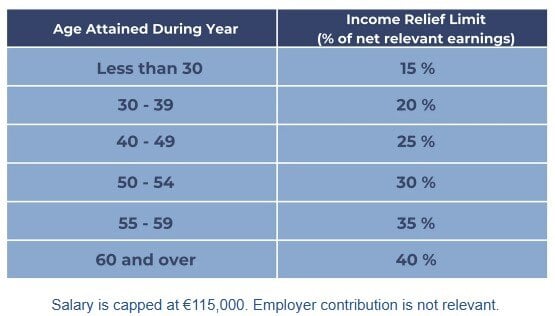
The maximum earnings figure taken into account when calculating pension tax relief is currently €115,000 per year. These percentages apply to the combined total of the employee’s personal pension contributions, including regular employee contributions and AVCs. Employer pension contributions are not taken into account when calculating the employee’s earnings threshold for this purpose.
How Much can I Contribute to an AVC in Ireland?
The amount you can contribute and receive tax relief on will depend on:
-Your age
-Your relevant earnings
-Your existing employee pension contributions
-Any AVCs already made
-The Revenue earnings cap
-Your available taxable income
-The pension arrangement involved
The relevant age-related percentage is not an additional AVC allowance. It is the overall personal contribution limit, within which regular employee contributions and AVCs are counted.
Example of AVC tax relief
Assume an employee:
-Is aged 52
-Earns €80,000 a year
-Pays income tax at the 40% rate
-Has sufficient taxable income at that rate
-Has made no other employee pension contributions during the year
At age 52, the relevant age-related limit is 30%.
Maximum personal contribution eligible for tax relief:
€80,000 × 30% = €24,000
Illustrative income tax relief at 40%:
€24,000 × 40% = €9,600
Illustrative net cost after income tax relief:
€24,000 minus €9,600 = €14,400
This is a simplified illustration. If the employee is already making regular pension contributions, those contributions must be deducted when calculating the remaining scope for an AVC. The availability and timing of tax relief also depend on the individual’s circumstances. It is important to calculate the position correctly before making a substantial contribution.
Derradda’s https://www.derradda.ie/maximum-contribution-calculator can provide a helpful starting point.
How Do You Claim Tax Relief on AVCs?
Where an employer deducts pension contributions through payroll, the relevant income tax relief may usually be applied through payroll. If relief has not been applied through payroll, a PAYE taxpayer may be able to claim it through Revenue’s myAccount service. Revenue states that supporting documentation, such as an AVC certificate or detailed receipt, may be required when completing the Income Tax Return. Self-employed taxpayers generally claim pension tax relief through ROS.
Revenue provides further information in its official guide to claiming pension tax relief.
Keep all contribution certificates, receipts and payment confirmations provided by your pension firm.
Who Should Consider AVCs?
AVCs can be relevant at different stages of a person’s working life.
– Higher-rate taxpayers
Employees paying income tax at the higher rate may find AVCs attractive because qualifying contributions may receive relief at their marginal rate, subject to available income and Revenue limits.
-People approaching retirement
Someone approaching retirement may use AVCs to increase their retirement savings or address an identified pension shortfall. Any decision should take account of the remaining investment period, investment risk, charges and the likely retirement benefit options.
-Employees with pension gaps
Career breaks, periods of part-time employment or delayed pension saving can leave a person with less retirement provision than expected. Additional pension contributions may help address some of that shortfall.
-People receiving a bonus
An employee who receives a bonus may consider using part of it to make a pension contribution. The amount qualifying for tax relief will remain subject to the normal age-related and earnings limits.
-Company directors
A company director who is also an employee and a member of an occupational pension arrangement may have options for additional employee pension contributions. However, an employee AVC is not necessarily the same as an employer pension contribution. The most appropriate funding route will depend on the company structure, pension arrangement, remuneration and the director’s personal circumstances. Directors should obtain specific pension and tax advice rather than assuming that an AVC is automatically the most suitable contribution method.
-Public sector employees
Public sector employees may use AVCs to supplement the benefits provided by their main occupational pension scheme. The potential value of an AVC should be assessed alongside:
-Expected occupational pension benefits
-Pensionable service
-Retirement age
-Existing preserved benefits
-Additional service arrangements
-Expected retirement lump sum
-The employee’s wider financial position
As public sector pension benefits can be complex, it is important to review the complete position before recommending an AVC.
AVCs Versus Other Ways to Save for Retirement
When considering a pension top-up in Ireland, it is useful to compare AVCs with other savings and investment options.
AVCs
AVCs may provide immediate income tax relief at the contributor’s marginal rate, subject to Revenue limits. The funds are specifically intended for retirement and are generally not freely accessible beforehand.
Personal savings
Cash savings are accessible and can be useful for emergencies or shorter-term goals. However, they do not generally provide pension contribution tax relief, and inflation can reduce their spending power over time.
Personal investments
Investments held outside a pension can provide flexibility and access, but returns may be subject to the tax rules that apply to the investment concerned. They do not generally receive the same upfront income tax relief as qualifying pension contributions.
Mortgage or debt repayment
Reducing debt can provide a valuable financial benefit, particularly where interest rates are high. It may also improve financial security before retirement. The right balance will depend on your emergency savings, debts, investment timeframe, attitude to risk, access requirements and retirement objectives. Pension tax relief is valuable, but it should not come at the expense of necessary short-term financial security.
What Happens to AVCs at Retirement?
The options available for an AVC fund at retirement depend on the underlying pension arrangement, the main occupational scheme, Revenue rules and the individual’s circumstances. Potential options may include:
Retirement lump sum
An AVC may help fund or increase a retirement lump sum, subject to scheme rules, the method used to calculate benefits and Revenue limits. The amount available tax-free should be confirmed as part of a full retirement benefit calculation. It should not be assumed that the entire AVC fund can automatically be taken tax-free.
Approved Retirement Fund
Where permitted, some or all of the remaining fund may be transferred to an Approved Retirement Fund, commonly known as an ARF. An ARF keeps the money invested after retirement and allows withdrawals to be made. Withdrawals are generally treated as taxable income, and investment values can rise or fall.
Annuity
An annuity converts some or all of the pension fund into a retirement income, typically payable for life. The level of income available will depend on factors including the fund value, age, annuity rates and the options selected.
A combination of options
Some retirees may use a combination of a lump sum, an ARF and an annuity. The available combination will depend on the pension rules and the person’s wider retirement position. A full retirement review should consider income needs, other assets, State Pension expectations, taxation, investment risk and provision for dependants.
Common AVC Mistakes to Avoid
Treating the age-related limit as a separate AVC allowance
The percentage limit covers the employee’s combined personal contributions. Existing employee contributions must be included when calculating the available room for an AVC.
Assuming everyone receives 40% tax relief
Tax relief depends on the contributor’s marginal tax rate and taxable income. Not every contributor will receive relief at 40% on the full contribution.
Waiting until the tax deadline
Revenue and provider requirements must both be met. Leaving a lump-sum AVC until the last moment creates a risk that the payment or documentation will not be processed within the required period.
Contributing money that may be needed soon
Pension funds are long-term retirement assets. They should not be treated as an emergency savings account.
Ignoring investment risk and charges
Tax relief is only one part of the decision. Fund choice, charges, investment timeframe and risk tolerance can materially affect the eventual outcome.
Failing to review all existing pensions
An AVC should be assessed alongside existing occupational pensions, personal pensions, PRSAs and preserved benefits from previous employment.
Not reviewing retirement benefit options
The way an AVC can be used at retirement depends on the relevant pension arrangement and individual circumstances. Planning should begin before the intended retirement date.
Frequently Asked Questions About AVCs in Ireland
AVCs are Additional Voluntary Contributions made by an employee on top of their normal pension contributions. They are intended to increase retirement savings and may qualify for income tax relief, subject to Revenue rules.
Do AVCs qualify for income tax relief?
Qualifying AVCs may receive income tax relief at the contributor’s marginal rate. Relief is subject to age-related percentage limits, the €115,000 earnings cap and the contributor’s income and existing personal pension contributions.
Do AVCs reduce USC or PRSI?
No. Revenue states that employee pension contributions do not receive relief from USC or PRSI.
How much can I contribute to an AVC?
The tax-relievable amount depends on your age, relevant earnings and existing employee pension contributions. The applicable age-related limits range from 15% for those under 30 to 40% for those aged 60 or over.
What is the pension earnings cap in Ireland?
The maximum annual earnings figure currently taken into account when calculating personal pension contribution tax relief is €115,000.
Can I make a once-off Lumpsum AVC?
Yes a once-off AVC is possible, subject to the pension arrangement and provider.
Can I make AVCs through payroll?
AVCs may be available through payroll where the employer’s pension arrangements support them. The available process should be checked with the employer, pension scheme administrator or financial adviser.
Can I stop or change my AVCs?
This will depend on the scheme and provider. Regular AVCs can often be changed, reduced or stopped, but the specific terms should be confirmed before setting them up.
Are AVCs suitable for public sector employees?
AVCs may help public sector employees supplement their expected occupational pension benefits. Their suitability should be assessed alongside the individual’s service, expected scheme benefits, retirement date and wider financial position.
Can company directors make AVCs?
A director who is an employee and a member of an occupational pension arrangement may be able to make AVCs. The appropriate structure depends on the pension scheme, remuneration arrangements and the director’s circumstances.
What happens to my AVC when I retire?
Depending on the pension arrangement and Revenue rules, the fund may be used towards a retirement lump sum, an ARF, an annuity or a combination of permitted retirement benefits.
Is an AVC the same as an employer pension contribution?
No. An AVC is an additional personal contribution made by an employee. An employer contribution is made by the employer and is subject to a different set of pension and tax rules.
Is an AVC better than a PRSA?
This is not always a like-for-like comparison because a PRSA can be used for AVC purposes. The correct arrangement depends on the individual’s employment, existing occupational pension scheme and retirement objectives.
How Derradda Financial Services Can Help
At Derradda Financial Services, we provide personalised pension and retirement planning advice designed around your circumstances and long-term goals. Our financial advisers can help you:
- Calculate your available pension contribution allowance
- Review your existing employee contributions
- Assess whether an AVC is suitable
- Compare regular and once-off contribution options
- Review a PRSA AVC where appropriate
- Evaluate pension funds, risk and charges
- Review benefits from previous employment
- Plan how benefits may be taken at retirement
- Develop a sustainable retirement income strategy
You can use our https://www.derradda.ie/tax-relief-calculator to see how income tax relief could affect the cost of a pension contribution.
If you already have one or more pension arrangements, you can also request a Derradda pension review.
Ready to Maximise Your Pension?
If you would like to understand how much you could contribute, whether an AVC is suitable or how pension tax relief may apply to you, the Derradda team is here to help. A personalised pension review can help you understand:
- Your available contribution limits
- Your projected retirement income
- Potential pension shortfalls
- The tax relief that may be available
- Your investment and retirement benefit options
Book a no-obligation pension consultation with Derradda Financial Services.
📞Call us: Dublin Office 01 2330209 /Galway Office 091 399256
📧 Email us: info@derradda.ie
Important Information
The value of investments can fall as well as rise. You may receive back less than you invest. Pension funds are generally intended for long-term retirement planning and access is restricted. Tax treatment depends on individual circumstances and may change in the future. Contribution limits, retirement benefit options and tax relief are subject to Revenue rules and the terms of the relevant pension arrangement. This article is provided for general information only and does not constitute financial, tax or legal advice. Professional advice should be obtained before making pension or investment decisions.